If you see the words “honey process” on a bag of coffee, it is easy to assume that honey was added somewhere along the way.
It wasn’t.
Honey processing has nothing to do with adding honey, sugar, or flavoring to coffee. The name comes from the naturally sweet, sticky layer of fruit surrounding the coffee seed—known as mucilage—and what happens when some of that layer is intentionally left in place during drying.
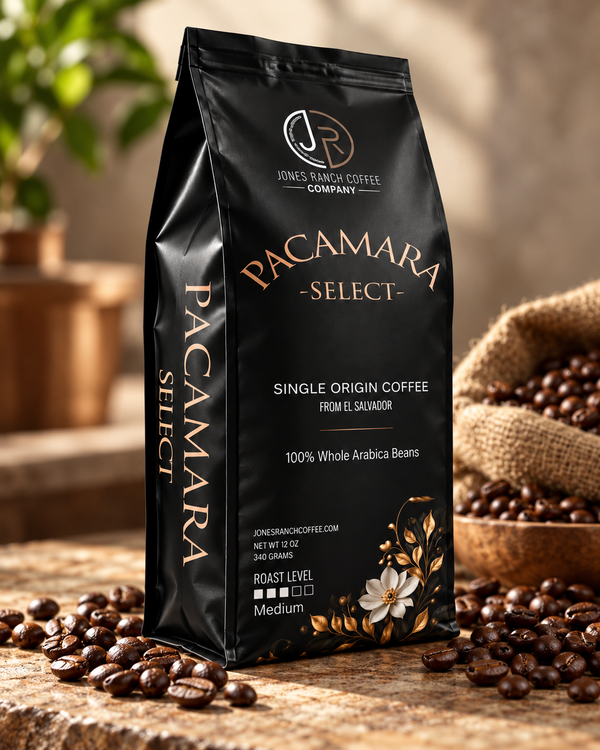
It is also one of the reasons our Pacamara Select from El Salvador is such a distinctive coffee.
Pacamara is already an unusual variety. Known for its exceptionally large coffee seed and expressive flavor potential, it stands apart before processing even begins. Pairing that variety with honey processing adds another layer of sweetness, body, and complexity to the final cup.
It Starts With the Coffee Cherry
Coffee begins as a fruit.
Inside each ripe coffee cherry are typically two seeds surrounded by several layers of fruit, including pulp and a naturally sticky layer of mucilage.
What happens to that fruit after harvest matters.
A lot.
With a washed process, most of the fruit and mucilage are removed before the coffee is dried.
With a natural process, the coffee is dried with the cherry largely intact.
The honey process falls somewhere between the two.
The outer skin and pulp are removed, but a portion of the mucilage remains on the coffee while it dries.
That remaining fruit material contains naturally occurring sugars and creates an environment in which careful drying and fermentation can influence the coffee's final character.
Why Honey Process Pacamara?
Pacamara is not a variety that needs help standing out.
Originally developed in El Salvador, Pacamara is known for its unusually large size and its potential to produce complex, aromatic, and highly expressive coffees.
That makes processing particularly important.
With our Pacamara Select, honey processing allows some of the natural fruit material to remain with the coffee during drying rather than removing it immediately.
The goal is not to make the coffee taste like honey.
Instead, the process can help develop qualities such as:
- Pronounced natural sweetness
- Fuller body
- Fruit-forward character
- Greater complexity
- A smooth, rounded finish
Those characteristics work especially well with a coffee like Pacamara because the variety already brings a strong identity of its own.
The process should complement that identity—not bury it.
Honey Processing Requires Precision
Leaving mucilage on the coffee creates opportunities for flavor development, but it also requires close attention.
The coffee must be carefully managed as it dries.
Temperature, humidity, airflow, drying time, fermentation, and how frequently the coffee is turned can all influence the result.
Because the remaining mucilage is sticky, the coffee can clump together during drying. Uneven drying or poorly controlled fermentation can lead to unwanted flavors or defects.
So while honey processing may sound like a simple middle ground between washed and natural coffee, it is anything but passive.
It requires deliberate decisions throughout the process.
That is part of what makes it interesting to us.
Yellow Honey, Red Honey, Black Honey—What Does It Mean?
Honey processing sometimes gets broken into categories such as yellow honey, red honey, and black honey.
Generally, these terms relate to differences in how much mucilage remains on the coffee and how the drying process is managed.
Darker honey processes often involve more retained mucilage or slower drying, while lighter honey processes may involve less mucilage or faster drying.
But there is an important distinction consumers should understand:
There is no single universal standard for these classifications.
A red honey process from one producer may not be identical to a red honey process somewhere else.
That is why we focus less on chasing a processing label and more on understanding the coffee itself—its origin, variety, processing, and ultimately how everything comes together in the cup.
Pacamara Select: Where Variety and Process Meet
Our Pacamara Select comes from El Salvador and represents exactly the type of coffee we want to bring to JRCC customers: a distinctive variety, a clearly defined origin, and a processing method chosen to bring out something special.
The Pacamara variety immediately stands out because of its characteristic large coffee seed.
But size alone is not what makes it interesting.
Pacamara has developed a reputation among specialty coffee drinkers because of the complexity it can produce when grown and processed well.
Honey processing adds another dimension.
By leaving part of the coffee fruit's mucilage in place during drying, the producer has an opportunity to encourage sweetness and complexity while still maintaining definition in the cup.
That combination is what makes Pacamara Select different from the more traditional washed coffees many people encounter every day.
Processing Is Part of the Story
At Jones Ranch Coffee Company, we believe the story of a coffee starts long before roasting.
- Variety matters.
- Where it was grown matters.
- Harvesting matters.
- Processing matters.
- Drying matters.
- And the decisions made by producers at origin ultimately follow that coffee all the way into your cup.
Our role is not to erase those differences.
It is to preserve them.
That is one of the reasons Pacamara Select earned a place in our lineup.
It combines an exceptional Salvadoran coffee variety with a honey process that adds another layer to what was already there.
So the next time you see the words “Honey Process” on a coffee, you will know there is no honey being added.
And if that coffee happens to be Pacamara Select, you will also know exactly why we thought the combination was worth sharing.
No honey added. Just an extraordinary coffee, its natural fruit, and a process designed to let it show you what it can do.



![Stagg [Xf] Pour-Over Coffee Maker Set](http://jonesranchcoffee.com/cdn/shop/files/stagg-xf-pour-over-coffee-maker-set-146313.jpg?v=1750628543&width=600 "Stagg [Xf] Pour-Over Coffee Maker Set")